- Location: Guadalajara, Mexico
- Project Year: 2023
- Built: 2023 -
- Design Team: Carlos Ruis Palomino, Pablo Huerta, Julia Zavala
- Renderings: Alfonso Castellón
- Structural Design: Cero Motion - Juan Jesús Aguirre
- Plot: 8,591.60 m2
- Project Area: 57,010.55 m2
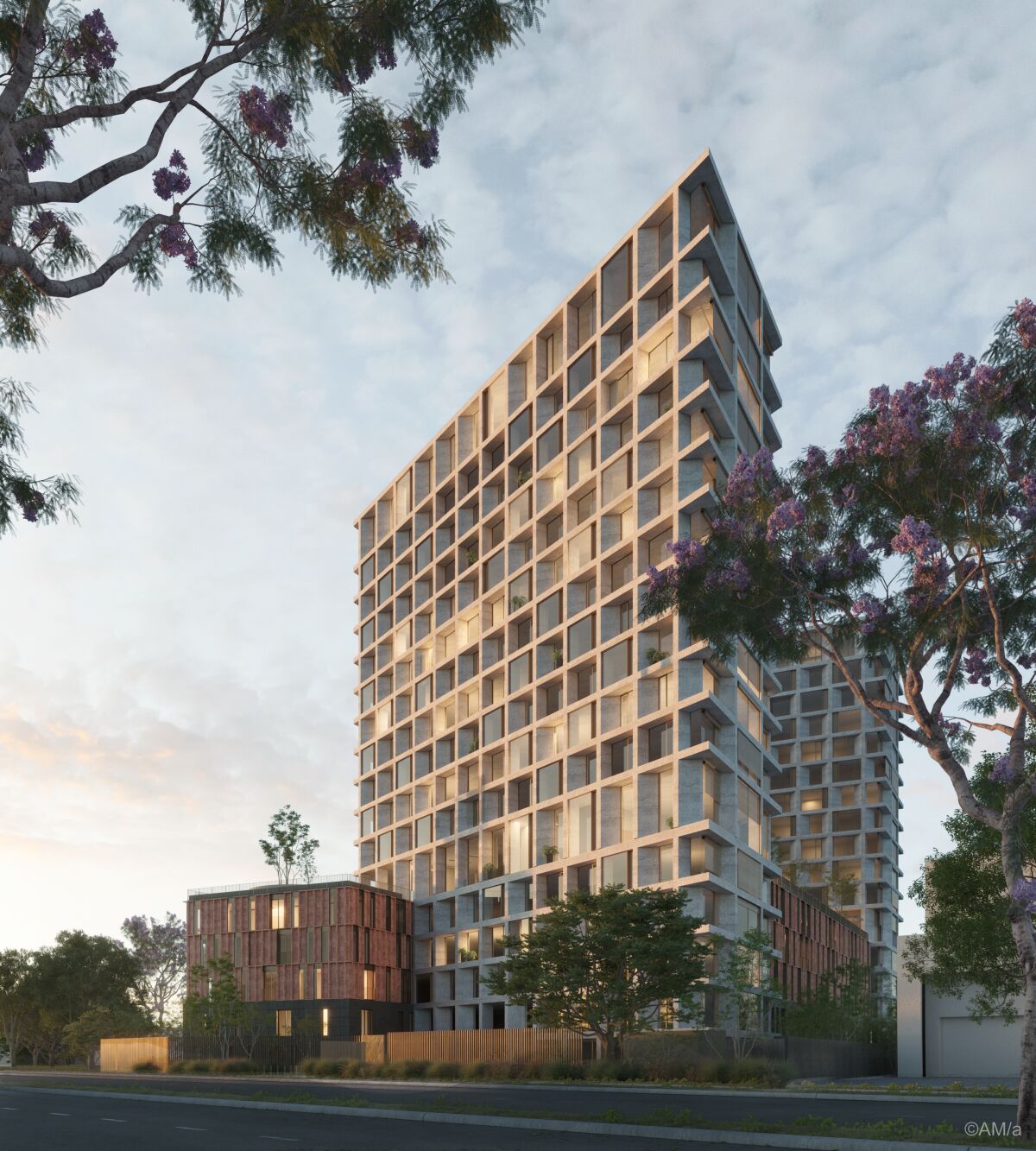
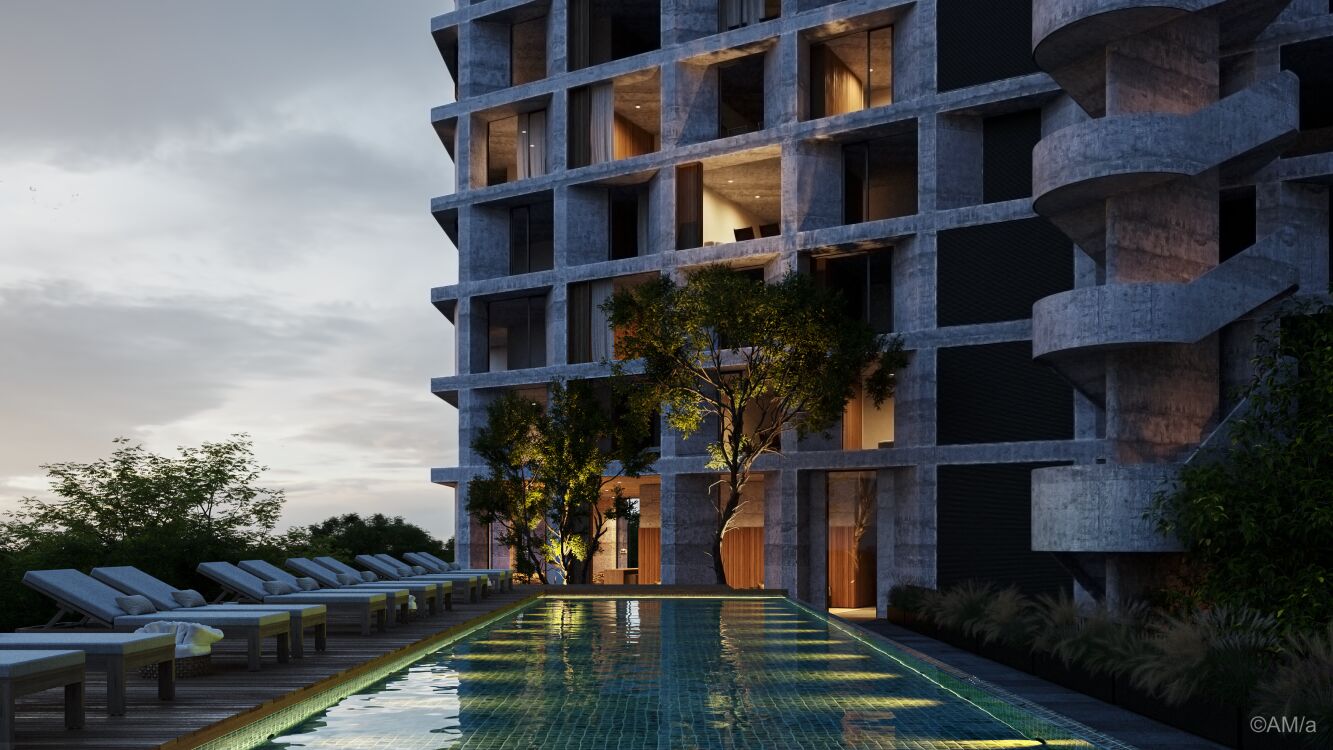
Quadrante is articulated through a volumetric strategy of clear compositional hierarchy: two towers of approximately eighteen stories rise above a mid-rise podium that functions as an urban plinth, establishing a stepped transition between the pedestrian scale of the street and the verticality of the upper prisms. The main façade of the towers features a reticular system of structural frames in rough-textured exposed concrete, whose regular modulation generates an orthogonal grid that disciplines the envelope without sacrificing interior programmatic variation. This tectonic lattice — evoking the brutalist tradition filtered through a contemporary sensibility — dialogues with the warm chromaticity of timber and the terracotta finishes of the podium, achieving a material duality that enriches the reading of the complex from the public realm.
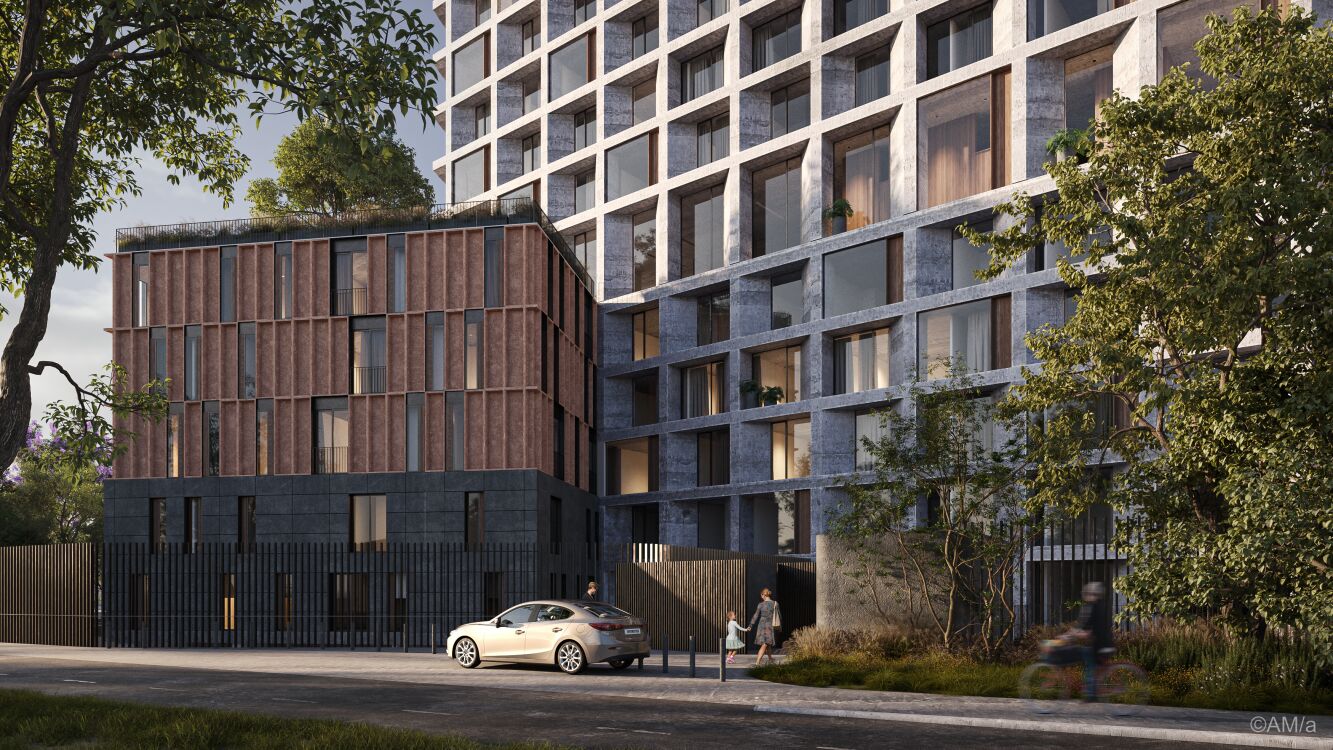
The podium, clad in reddish-hued panels and articulated through vertical fins of measured rhythm, absorbs the activities most directly engaged with the city — vehicular access, lobby — while its roof transforms into a landscaped platform housing a longitudinal infinity pool and collective leisure areas. This garden-roof serves as the programmatic threshold between the public and the residential, and its landscape design — featuring medium-canopy trees with grazing illumination and planted ground covers — reinforces the project’s bioclimatic ambitions, mitigating the urban heat island effect and promoting biodiversity within a densified urban fabric.
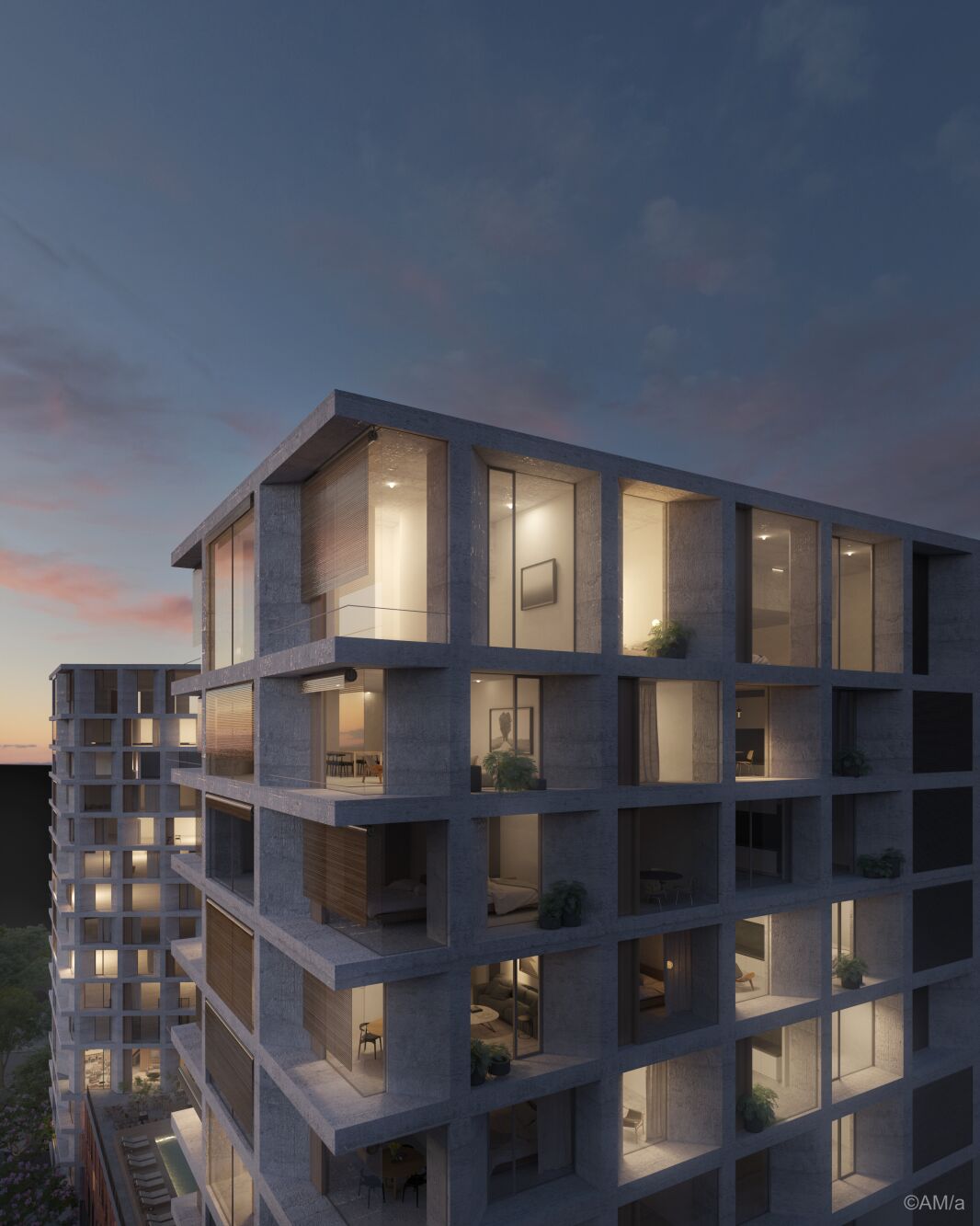
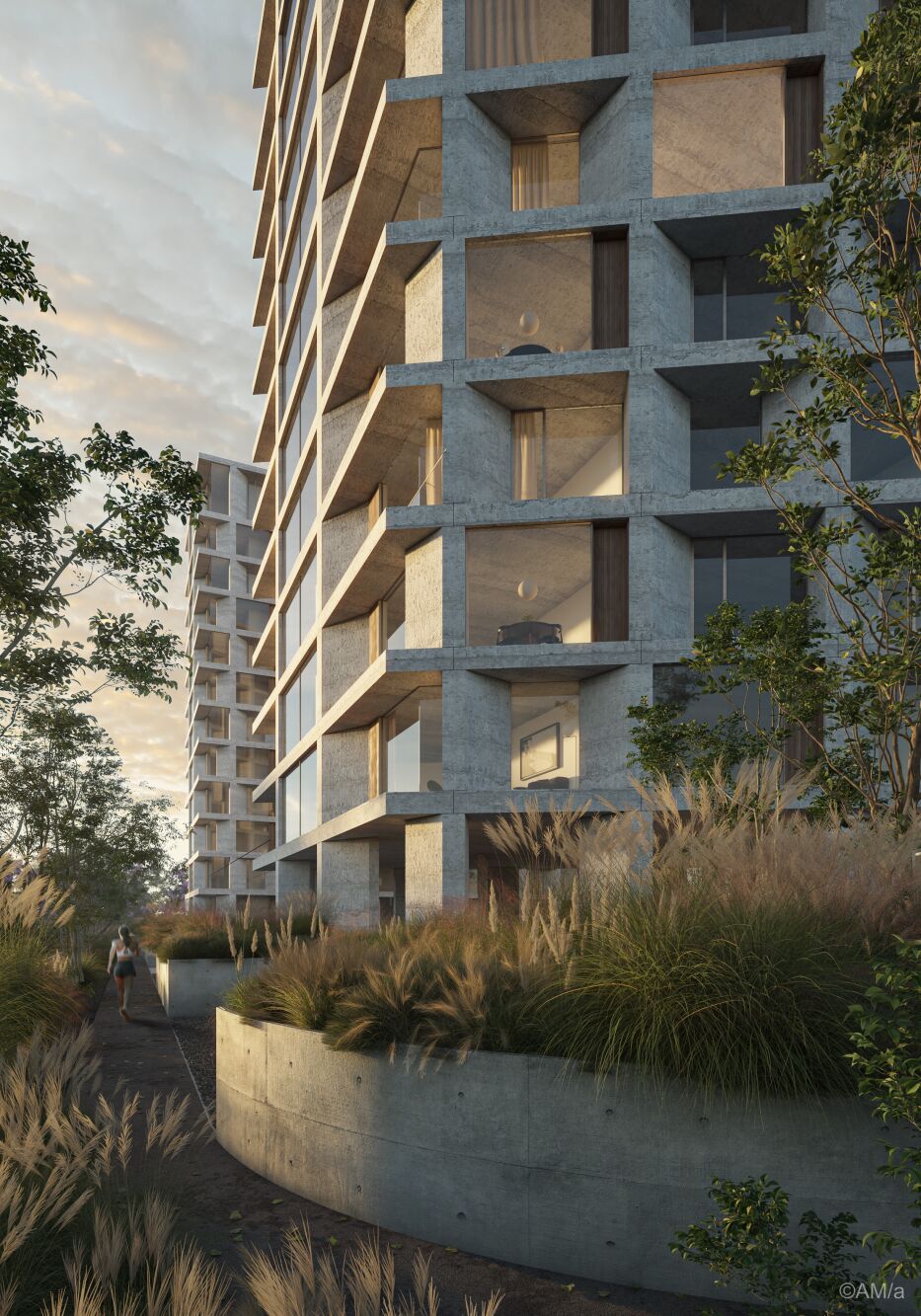
At the scale of detail, architectural quality is sustained through the constructive honesty of materials and the careful resolution of thresholds between interior and exterior. The apartments are organized behind the structural grid, whose varying depths generate loggias and cantilevers that modulate solar gain and confer privacy without compromising luminosity. The punctual vegetation integrated within the frames — ferns, climbing plants, shrubs — humanizes the façade and softens the forcefulness of the exposed concrete, while the perimeter landscaping of ornamental grasses and native trees establishes an ecological continuity with the arboreal context of the surrounding neighborhood. The result is a complex that intelligently negotiates the tensions inherent to high-density residential architecture: the relationship between mass and void, between collectivity and intimacy, between the permanence of the tectonic and the transience of the natural.